
🌟From Self-Improvement To Spiritual Journaling In College
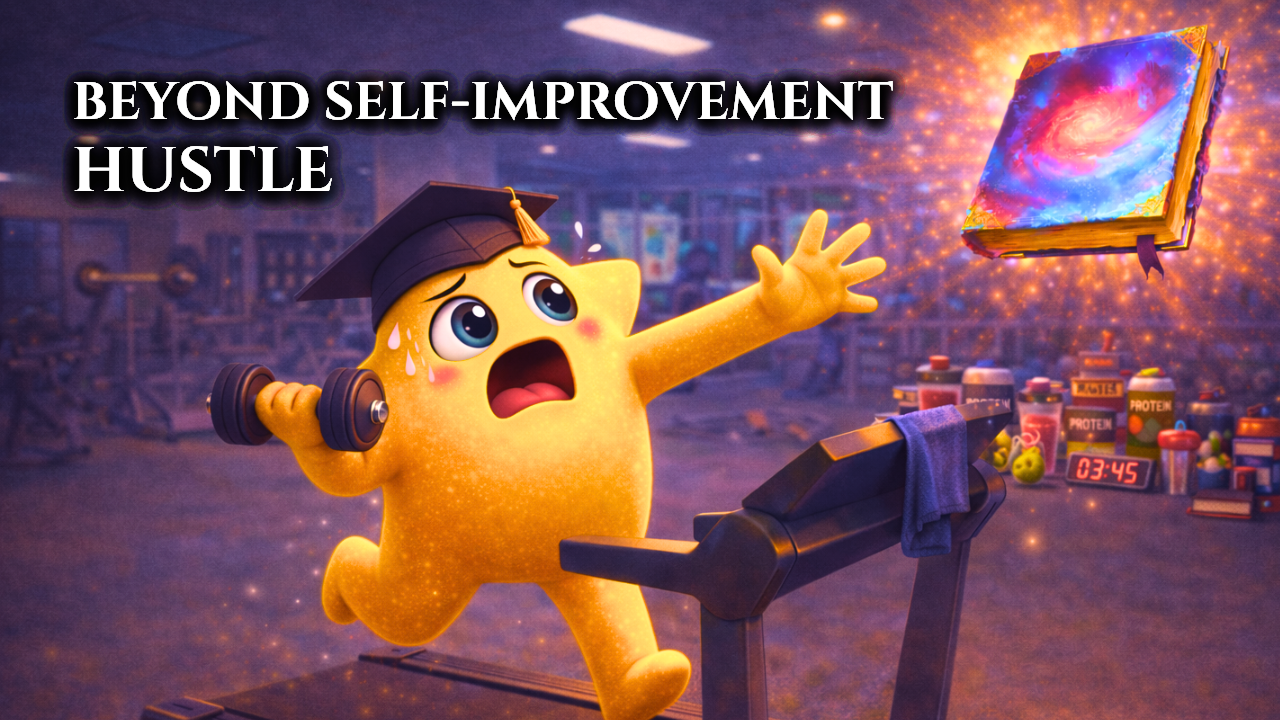
For my first semester at Cornell University, I unknowingly made self-improvement a religion.
I spent five hours every morning doing deep work, no distractions, laptop resting on my hardcover copy of the 4 Hour Work Week. While my friends drank morning Boba, I clickity clacked, sipping from a $2.67 Rusty's coffee (all black). Because I was on a strict anabolic diet, if someone wanted to get lunch an hour outside of my eating window, I ate by myself. Every night I went to bed at 9:00 p.m. and read from How To Win Friends & Influence People. This guaranteed nine hours of sleep to fuel my seven day split of resistance training and 5k race preparation.
Only in my second semester, after I lost my friend group, got my first college B, and didn't even have the energy to exercise one day a week did I realize... Something. Something might be off.
Self-improvement had become a prison to true growth.
I constantly felt inadequate, seeing every aspect of my life not for what beauty it already held, but for what lack it spoke. Everything was about hustle and optimization. I productively procrastinated, injecting deep work and health obsession into my veins as a distraction from navigating true internal challenges. I became more disconnected from others, measuring everyone by the self-improvement ruler.
Most importantly, my self-improvement journey lacked Spirituality. And that, was the true tragedy.
Spirituality—more specifically Spiritual journaling—is the art of journaling to grow your knowledge, love, and consciousness so you can realize your true Oneness with everything in the Universe.
The problem with self-improvement is it puts the cart before the horse. Here's how Spirituality differs from self-improvement:
- Where self-improvement is about filling holes of lacking, Spirituality is about building radiant towers on top of the beauty you already are.
- Where self-improvement is about productively procrastinating on true growth, Spirituality is about tackling the root internal challenge creating your external challenges, paradoxically synergizing with traditional success.
- Where self-improvement is about practically building a more solid sense of self, Spirituality is transcending the self to better the whole cosmos.
Since my self-improvement obsession, I've created 1,000+ journal entry's, 600+ YT videos, blog posts, and podcasts, meditated for 1,000+ hours, and made a free Cosmic Journaling Kit helping college freshmen integrate the Spiritual journaling insights I discuss. I want to help you transcend self-improvement while avoiding a lot of the mistakes I made in college.
With that in mind, let's dive into what Spiritual journaling is and how to do it.
What is Spiritual Journaling?
As said earlier, Spiritual journaling is the art of using journaling to grow your knowledge, love, and consciousness so you can realize your true Oneness with everything in the Universe.
It's called "Spirit-uality" because "Spirit" is the true essence of something, and your true essence is reality itself, Infinite Consciousness, Absolute Infinity, some might even say God (though for me a secular one). "Uality" refers to Non-Duality, Enlightenment, Awakening, the realization that there is Absolutely no difference, no duality, between you and anything else except that which is imagined.
Essentially, Spiritual journaling is not:
- Religion
- Ideology
- Anti-science
- Fearing death
- Proving things
- Adopting beliefs
- New Age Spirituality
- Simply more self-improvement
There are eight gates to Spiritual Journaling roughly in my recommended order of progression:
- Spiritual Prep: Ensuring you are in the right state of mind and environment to begin truly diving into Spiritual journaling.
- Ecology of Practices: Building an Ecology of Practices outside only Spiritual Journaling which check and balance each other.
- Self And Survival: Understanding the nature of your relative self, why and how it attempts to survive, and how it affects your Spiritual journey.
- Growing Up & Waking Up: Integrating the two main pathways to pursuing Spirituality across West and East.
- Spiritual Shadow: Navigating how your Spiritual Shadow is keeping you attached to your relative self.
- Knowledge: Exploring what Truth is both relative and Absolute and how you can pursue it.
- Love: Appreciating love not as just an emotion or action, but as a metaphysical relationship with reality itself.
- Consciousness: Realizing your infinite nature as Spirit, Absolute Infinity, Infinite Consciousness, God.
Importantly, the journaling questions related to each of these eight gates uses terminology from my Cosmic Journaling Kit (CJK) like Cosmic Compass, Shadow Compass, and College Constellations.
The Cosmic Compass is your guiding light in college including your life purpose/career, values, ideal self, and more. The Shadow Compass is everything which can make (but sometimes help) that more difficult to pursue including your emotions, thought loops/limiting beliefs, desires, and more. Your College Constellations are the realms you can apply these Spiritual insights in like your health, classes, and relationships.
This article is not meant as a holistic and in depth overview of every single aspect of Spiritual journaling. That would require an entire book. Instead, I intend for this to be a holistic overview of the path. So don't worry if you don't understand what some of the terms mean.
Let's dive into each of the eight gates as well as some journaling questions you can ask to grow in each.
Spiritual Prep
Before you dive deep into Spiritual journaling there is some preparation you should do to make sure that one, you’re in a good enough set and setting, and two, you get the most out of it you can. Spiritual work can be very destabilizing for those not ready to embark on it.
One rule you MUST agree to follow if you’re going to do this work, okay? Your spiritual practice should not require you to do deep and permanent physical or mental harm to yourself. Nor should it make your life worse in the long term. If either of those things are happening, stop immediately and reassess. This is serious but beautiful stuff.
Journaling Questions
- Do you feel in a stable enough mental state and setting for your life right now to explore Spirituality?
- What reservations do you have regarding Spirituality and how might you be able to keep an open mind as you embark?
- What long-term Spiritual trajectory do you imagine for yourself and how can you enter into this constellation with that aliveness in you?
Ecology of Practices
Any good spiritual undertaking requires not just journaling, but an entire Ecology of Spiritual practices unique to YOU that can check and balance each other. That’s right, journaling is just one star in your Spiritual solar system.
In an ideal world, you would have one reflection practice, one contemplation practice, and one mindfulness practice. In addition, you would have one practice in each of the four quadrants of your college cosmos defined in Ken Wilber’s Integral Theory. Don’t worry if you don’t know what that is, it’s defined in the questions below.
After going through whatever questions are helpful below, come up with your own unique ecology of practices.
Journaling Questions
Outside journaling, what one reflection practice, one contemplation practice, and one mindfulness practice, can you build to dive deeper into Spirituality across all four quadrants of The College Cosmos? Quadrants explained below:
Ken Wilber’s quadrants:
- Upper-Left (UL): Interior–Individual → Inner experience
- Upper-Right (UR): Exterior–Individual → Your behaviors & body
- Lower-Left (LL): Interior–Collective → Shared meaning & culture
- Lower-Right (LR): Exterior–Collective → Systems, environments, structures
- What can you do in the next few weeks to learn more about and integrate the practices you chose above?
Self And Survival
The starting point of Spirituality comes with adressing the being you think you are, the self.
You might of heard it as ego, the devil, that thing that makes you procrastinate on every assignment ever. I encourage you not to see the self as a being to be distrusted and annoyed at, but rather as one more thing to transcend and integrate in your Spiritual journey.
These journaling questions will help you uncover what your self is like, learn to see how its surviving itself, and come to it with more compassion and love.
Self-Witnessing Journaling Questions
- Root in your awareness, your Witness: What is your relative self feeling, thinking, believing? What does it feel like to be grounded in the fact that this is not you?
- What parts of your Cosmic and Shadow compass as well as your College Constellations tend to bring you back into self?
- How can you root yourself more in The Witness throughout your day?
Self-Survival Journaling Questions
What are the main survival strategies you use to survive yourself moment to moment across your Cosmic and Shadow Compass as well as your College Constellations? Examples below:
- Over-intellectualizing: Staying in concepts to avoid feeling
- Analysis paralysis: Thinking endlessly so you never have to act
- Certainty seeking: Clinging to clear answers to avoid ambiguity
- Self-theorizing: Explaining yourself instead of experiencing yourself
- Meta-thinking: Thinking about thinking to stay one layer removed
- Skepticism as armor: Dismissing before being vulnerable
- Narrative control: Constantly explaining what’s happening to feel safe
- Emotional numbing: Flattening feelings to stay functional
- Premature positivity: Reframing pain too quickly
- Chronic self-soothing: Reaching for comfort to avoid discomfort
- Emotional suppression: Postponing feeling
- Emotional flooding: Letting feelings overwhelm so nothing changes
- Selective feeling: Allowing some emotions but banning others
- Stoicism: Attaching to the need of not controlling what you can’t control
- Busyness: Staying productive to avoid stillness
- Over-discipline: Rigid routines to avoid inner chaos
- Procrastination: Delaying to preserve self-image
- Perfectionism: Never finishing so you’re never judged
- Compulsive optimization: Always improving instead of being
- Escapism: Gaming, scrolling, substances, or fantasy to avoid presence
- Streak-keeping: Maintaining habits for identity rather than nourishment
- Achievement identity: Equating worth with accomplishment
- Helper / fixer identity: Focusing on others to avoid yourself
- “Gifted” identity: Protecting intelligence over growth
- Spiritual identity: Being “above” human messiness
- Rebel identity: Opposing systems instead of choosing freely
- Victim identity: Staying stuck because it explains pain
- Independent identity: Never needing support
- People-pleasing: Staying liked to stay safe
- Emotional caretaking: Managing others’ feelings
- Avoiding depth: Keeping relationships surface-level
- Attachment to intensity: Mistaking drama for connection
- Withdrawal: Disappearing instead of expressing needs
- Comparison: Using others to measure worth
- Choosing unavailable people: Desire without real risk
- Staying in familiar environments: Remaining where it’s predictable even if limiting
- Over-structuring life: Using calendars and systems as emotional containment
- Under-structuring life: Creating chaos to avoid responsibility
- Information overload: Consuming instead of integrating
- Echo chambers: Surrounding yourself with confirming views
- Constant stimulation: Noise to avoid silence
- Minimalism as control: Reducing life to feel safe
- Projection: Seeing in others what you can’t face in yourself
- Moral superiority: Staying “right” to stay safe
- Spiritual bypassing: Using insight to avoid pain
- Cynicism: Dismissing meaning before it can disappoint you
- Humor as deflection: Joking when things get real
- Detachment: Not caring so much that you attach to detachment
- Resignation: Calling survival “acceptance”
What major self-deceptions does your self use across your Cosmic and Shadow Compass as well as your College Constellations? Examples below:
- Thinking you’ve basically got reality figured out: You mistake partial understanding for the whole, closing yourself off from deeper insight.
- Believing reality is objective and mind plays little role in it: You assume perception is neutral rather than an active construction.
- Assuming self-deception is not significant: You overlook the ways your mind hides information from you.
- Thinking you can avoid metaphysics: You unconsciously rely on metaphysical assumptions while believing you have none.
- Conceptualization (confusing the map for the territory): You treat ideas about reality as if they were reality itself.
- Language and labeling: Words create illusions of understanding that obscure direct experience.
- Belief and hearsay: You adopt “truths” secondhand without investigating them.
- Unwillingness to admit “I don’t know”: Ego resists uncertainty because it threatens your identity.
- Childhood imprinting and indoctrination: Early beliefs shape perception so strongly you mistake them for universal truths.
- Need for contrast to grasp something: You only understand things in opposites, which creates distorted binaries.
- Assumptions: You rely on unquestioned premises that frame everything else you see.
- Self-evidence (Apriority): You take something as obviously true simply because it feels intuitive.
- Emotions: Emotional reactions masquerade as rational conclusions.
- Not being conscious of your own ego reactions: You defend identity without realizing you’re doing it.
- Projection: You attribute your own traits or motives to others so you don’t have to confront them in yourself.
- Distraction and red herrings: The mind fixates on irrelevant details to avoid uncomfortable truths.
- Believing science has figured it all out (or will): You assume the current paradigm is nearly complete, ignoring its limits.
- Pet theory attachment: You cling to one preferred explanation and distort evidence to fit it.
- Confirmation bias: You selectively seek evidence that supports what you already believe.
- Cherry-picking and narrative making: You stitch together convenient stories that feel coherent but aren’t accurate.
- Ignoring conflicts of interest: You overlook incentives that bias your own or others’ conclusions.
- Double standards: You judge others by strict rules while giving yourself exceptions.
- Hindsight bias: You believe you “knew it all along,” rewriting the past to protect ego.
- Fragmentation: You assume breaking reality into parts gives objective understanding, ignoring holistic context.
- Equating intelligence with competence: You believe cognitive ability automatically translates to wise action.
- Seeing intelligence as a net good: You overlook how intelligence amplifies self-deception when not paired with wisdom.
- Believing truth must be provable: You dismiss aspects of reality that cannot be measured or demonstrated.
- Assuming everyone has your brain chemistry: You project your internal experience onto others as if universal.
- Not seeing historical meta-narratives: You uncritically accept the dominant cultural story about progress and civilization.
- Thinking modern society is wise because it’s advanced: You confuse technological progress with Spiritual or psychological maturity.
- Arrogance: You assume superiority in understanding, blinding yourself to blind spots.
- Focusing too much on others’ self-deception: You analyze them to avoid looking at your own shadows.
- Pragmatic bias: You dismiss things without immediate utility, missing deeper forms of value.
- Groupthink: You conform to collective assumptions to avoid social friction.
- Talking and knowing versus embodying: You mistake intellectual understanding for lived transformation.
- Mistaking content for structure: Mistaking the face value of something as the relationship someone has to it.
- Understanding but not appreciating: Trivializing something for its face value without realizing its the appreciating where the value comes.
- How can you navigate those self-deceptions and survival strategies?
Collective Self-Survival Journaling Questions
What are the main collective survival strategies you use to survive yourself moment to moment across your Cosmic and Shadow Compass as well as your College Constellations? Examples below:
- Productivity worship: Treating constant output as proof of worth
- Credential chasing: Accumulating degrees, titles, or prestige to feel legitimate
- Status comparison: Measuring self through rankings, followers, or achievements
- Hustle normalization: Equating exhaustion with virtue
- Busyness as belonging: Staying overwhelmed to feel included
- Optimization culture: Treating life as a system to maximize rather than experience
- Grade fixation: Confusing performance metrics with learning or intelligence
- Resume identity: Reducing selfhood to bullet points and accomplishments
- Career tunnel vision: Narrowing life choices to what is “marketable”
- Internship panic cycles: Collective urgency driven by perceived timelines
- Prestige mirroring: Wanting what high-status peers want
- Emotional minimalism: Expressing only what is socially acceptable
- Irony and detachment: Using humor or cynicism to avoid sincerity
- Performative vulnerability: Sharing feelings for approval rather than integration
- Therapy-speak avoidance: Naming emotions instead of actually feeling them
- Stoicism-as-maturity: Suppressing needs to appear strong or evolved
- Groupthink: Adopting shared assumptions to avoid social friction
- Opinion outsourcing: Letting consensus decide what’s true or valuable
- Trend alignment: Syncing beliefs to cultural moments instead of inner clarity
- Moral signaling: Expressing values to belong rather than embodying them
- Cancel fear: Self-censoring to avoid social punishment
- Information hoarding: Consuming endlessly to avoid acting
- Expert dependence: Trusting authority figures over lived experience
- Science-as-shield: Using data to avoid existential uncertainty
- Hot-take culture: Preferring certainty and speed over nuance
- Narrative addiction: Needing clean stories to tolerate complexity
- Spiritual bypass culture: Using “oneness” or “detachment” to avoid pain
- Enlightenment chasing: Treating awakening as an achievement
- Aesthetic spirituality: Curating the appearance of depth
- Anti-ego ego: Feeling superior for “having no ego”
- Premature transcendence: Skipping developmental work for cosmic conclusions
- Algorithmic living: Letting feeds shape attention and desire
- Constant availability: Being reachable to avoid missing relevance
- Notification dependency: Using interruption as emotional regulation
- Digital identity maintenance: Managing online self to feel real
- Validation loops: Checking metrics to confirm existence
- Scarcity thinking: Acting as if there’s never enough time, love, or opportunity
- Zero-sum success: Believing someone else’s win threatens yours
- Safety-through-conformity: Choosing what’s acceptable over what’s true
- Future deferral: Postponing aliveness until “later”
- Survival as normalcy: Mistaking coping for living
How the major groups or institutions you are in self-decieving themselves about their survival?
- Normalizing survival: Treating chronic stress, anxiety, and burnout as “just how life is”
- Collective denial: Agreeing not to see what is obvious because seeing it would demand change
- Progress mythology: Assuming things are getting wiser simply because they are getting faster or more advanced
- Technological salvation: Believing tools will fix problems created by consciousness and values
- Metric substitution: Replacing what matters with what can be measured
- Efficiency worship: Valuing speed and scale over depth and meaning
- Institutional gaslighting: Framing systemic problems as individual failures
- Meritocracy illusion: Believing outcomes purely reflect effort or talent
- Credential laundering: Using degrees and titles to signal wisdom instead of cultivating it
- Prestige blindness: Assuming high-status institutions are aligned with truth
- Responsibility diffusion: No one acts because “it’s not my role”
- Cultural anesthesia: Using entertainment, noise, and stimulation to avoid existential discomfort
- Distraction-as-freedom: Mistaking endless choice and content for agency
- Busyness consensus: Agreeing that everyone is “too busy” to slow down
- Urgency fabrication: Manufacturing deadlines to avoid deeper questions
- Future outsourcing: Believing meaning will arrive later
- Emotional minimization: Treating deep feeling as weakness or inefficiency
- Stoicism theater: Performing resilience instead of cultivating it
- Performative care: Signaling concern without real sacrifice or change
- Empathy inflation: Talking about compassion more than practicing it
- Conflict avoidance: Calling suppression “harmony”
- Consensus epistemology: Treating popularity as truth
- Authority outsourcing: Letting institutions think on behalf of the collective
- Expert overreach: Believing specialization equals wisdom about life
- Reductionism: Explaining away complexity to maintain control
- False neutrality: Pretending values aren’t shaping decisions
- Spiritual bypass culture: Using transcendence language to avoid collective grief
- Enlightenment exceptionalism: Believing awakening exempts one from responsibility
- Anti-ego ego: Feeling superior for “seeing through” society while still benefiting from it
- Detached compassion: Caring abstractly while remaining uninvolved
- Premature unity: Claiming “we’re all one” to avoid reckoning with harm
- Moral outsourcing: Letting laws, policies, or systems decide what’s right
- Incrementalism trance: Making changes small enough to never threaten the system
- Crisis normalization: Treating emergencies as permanent background conditions
- Adaptation pride: Celebrating resilience instead of questioning what required it
- Survival equated with success: Calling endurance a good life
- How can you navigate those collective self-deceptions?
Growing Up & Waking Up
In spirituality, there are two primary pathways of development: growing up and waking up.
Growing up is all about developing how you make meaning—the structure of your worldview, the complexity of your thinking, your level of perspective-taking, and your capacity for wisdom. These are the developmental “levels” studied across psychology, anthropology, cognitive science, moral development, and cultural evolution. This territory has been mapped primarily by Western traditions.
Waking up, in contrast, is about developing what you make meaning of—the depth of consciousness from ordinary waking experience into subtle, causal, and ultimately Enlightened Non-Dual states. This territory comes mostly from Eastern contemplative traditions.
For most of human history, these two spectrums have been separate.
People grew up psychologically without waking up spiritually, or woke up spiritually without growing up psychologically—leading to massive spiritual blind spots, ego distortions, and developmental ceilings.
Modern Integral Spirituality, developed by Ken Wilber, changes this.
The highest form of spirituality integrates both:
- You Grow Up (develop psychological maturity)
- While you Wake Up (experience higher states of consciousness)
- So you become someone who can actually hold, express, and embody Enlightenment in a functional, wise, grounded way
The questions below will help you pursue both.
Journaling Questions Growing Up
What structure of human development do you believe you’re grounded in and why?
- Archaic — Infrared
- Magic — Magenta
- Magic Mythic — Red
- Mythic — Amber
- Rational — Orange
- Pluralistic — Green
- Integral — Teal
- Super-Integral — Turquoise
- Illuminated Mind — Indigo
- Meta-Mind — Violet
- Overmind — Ultraviolet
- Supermind — Clear / White
- How does this grounding structure influence how you make meaning from your Cosmic and Shadow Compass as well as your College Constellations and why?
- What actions can you take in the next few weeks with this in mind?
Journaling Questions Waking Up
- How is your current structural level affecting the way you interpret each of the states you have experienced?
- What’s the highest state of consciousness you have experienced and how can you ground yourself more in that state?
- How does it feel when you’re experiencing states higher than the gross state? What are you sensing, perceiving, feeling, thinking, etc.?
Spiritual Shadow
It’s exactly the profundity and enormity of Spirituality that makes it the most ripe for selfishness, traps, and misinterpretation. It’s like trying to play chess against a grandmaster, with your eyes closed, while doing complex arithmetic.
The questions below are all meant to help guide you through the difficulties you’ll come across from your shadow while pursuing Spirituality.
Journaling Questions
- What are the most likely things from your Cosmic and Shadow Compass as well as your College Constellations that might shadow your Spiritual Growth, how might they affect you and why?
- What are the most likely things from your grounding structure and state levels that could shadow your Spiritual Growth, how might they affect you and why?
- What actions can you take over the next few weeks to navigate this?
Knowledge
"The first principle is that you must not fool yourself, and you are the easiest person to fool.” - Richard Feynman
What makes it even more confusing is when you’re skepticism towards yourself becomes what clouds you from knowledge and Truth. It’s like playing 5D chess but with a infinitely crafty deity. So basically yourself.
The questions below will unravel your entire notion of what knowing is, then stitch them back together, then unravel them again. Practically, this will ensure you’re grounded in radical Truth, aiding all your college constellations, especially your decisions. Spirituality, it will help you uncover the deepest nuances of reality. What could be more fulfilling?
Journaling Questions
- What does it mean to know something, and what is Truth?
- What do you know you think is closest to Truth and how do you know it’s close to Truth?
- How can you get closer to Truth?
Love
Unfortunately, our modern notion of love is a very low form. Most people see it as a feeling or action. But that’s just one facit of love.
Love is a metaphysical relationship with reality. It’s pure isness. It is being. It’s everything. This includes the previous notion of love and then transcends it.
The questions below will all help you understand this love deeper, and build it for yourself to improve all your life domains, than realize that there was never anything to improve, just love all the way down.
Journaling Questions
- What is love? (BABY DON’T HURT ME. I’m sorry I had to). When you’ve felt tremendous love, what has it been like? How can you turn that love towards EVERYTHING?
- What in your Shadow and Cosmic Compass as well as your College Constellations is making it more difficult to love metaphysically?
- What about your grounding structure or state is making it harder to love metaphysically?
Consciousness
These journaling questions are the true cream of the crop, the most profound of the profound. Consciousness journaling questions are meant to help you realize your Oneness with everything in The Universe, because everything in The Universe is consciousness.
All of physics, all science, all anything is essentially consciousness studying itself. You’re Spirit, imagining itself as a finite human. This article is you, reminding yourself that you're imagining a separate but false me, illuminating your true nature.
Welcome to Spirit Realization, the ultimate ending point of Spirituality.
Journaling Questions
- Ground yourself in the realization that everything is consciousness, you are Spirit—what does it feel like to embody this insight? How would your life change if you accepted the idea that everything, every College Constellation you have gone through, was just Spirit coming to realize itself?
- What in your Cosmic and Shadow Compass as well as your College Constellations is resisting Spirit Realization and why?
- What in your structure and state grounding is resisting Spirit Realization and why?
Conclusion: From Self-Improvement To Spiritual Journaling
When I look back at my first year at Cornell, I don’t feel shame. I feel compassion.
That version of me wasn’t broken, arrogant, or secretly unwell—he was protecting himself. He built a cathedral of routines, metrics, and optimization because stillness felt dangerous. If he slowed down, something unmeasured might surface. Something that couldn’t be gamified, quantified, or solved with a podcast at 1.25× speed.
Self-improvement wasn’t a vanity project; it was armor.
And to be clear, self-improvement itself wasn’t the villain. It taught me discipline, agency, and responsibility. It showed me that effort matters and that life isn’t something that just happens to you. But it was incomplete. It gave me tools without giving me ground. Ladders everywhere, but no soil beneath them.
Spiritual Journaling was the thing that quietly changed the orientation of my life—not by tearing down that cathedral, but by letting vines grow through it. Instead of constantly asking, “How do I optimize this?” I learned to ask, “What is this revealing?” Instead of using productivity to outrun discomfort, I learned to sit with it long enough for it to speak. Instead of measuring my life by progress, I began to experience it through presence.
And paradoxically, that’s when my life actually began to grow.
Not cleaner. Not more impressive. Not more optimized. But more alive.
Spiritual Journaling didn’t make me less ambitious—it made my ambition less afraid. It didn’t permanently destroy my self; it gave my self somewhere to rest. A place where effort could exist without being the price of worth, and growth could happen without self-rejection lurking underneath it.
So if you recognize yourself in that first-year version of me—the disciplined one, the anxious one, the relentlessly improving one—I’m not here to tell you to abandon self-improvement. I don’t think you need to quit it. I think you need to integrate and transcend it.
When you’re ready, the journal is here.

If you found this post interesting you would love my free College Freshman Cosmic Journaling Kit (CJK). ✨📚
It's a gamified journaling system that helps you grow your emotional centeredness, self-understanding, and purpose with over 1,000+ journaling questions and 5+ templates in just 15 minutes a day.