❤️🔥Stop Letting Emotions Run Your College Life
As a college freshman, I thought my rational mind was orchestrating the show. In reality, my emotions were running every millisecond of my life.
Every day I'd get up at 6:00 a.m., run twice around Beebe Lake (3 miles, 5k if you're sensible), and grab a coffee from Rusty's (black). Then, I'd submerge into a focus lake for four to five hours straight typing YT scripts and doing schoolwork. If my friends wanted to get lunch, my strict anabolic diet meant it had to be in a 30-minute window or it was a no. After lunch, I begrudgingly donned by student persona and went to classes. Finally, at 6:00 p.m. I'd get dinner and read a book until bed. Rinse and repeat.
I thought I was a pretty emotionally stable guy.
It was only a few months later I realized not feeling emotions is not the same thing as not having emotions.
My carefully crafted routine was actually quarantining me from spontaneity and change. I was hiding myself from doubts like if I had the right friend group, if I was in the right major and career path, and if it was normal to think about exercise and food 26 hours a day. I buried the restlessness, anxiety, and self-doubt I did feel inside time blocks and caffeine.
Slowly the repercussions hit me.
I lost my first friend group. I felt so drained from exercise and eating like a rabbit, I could barely do any work. I cried myself to sleep some nights because of how lost I felt.
I knew things needed to change. And so I went to our begrudging lord and savior, The Amazon Kindle Store. There I searched for books on emotional intelligence. This kickstarted a four-year rabbit hole in which I’ve:
- Created over 600+ YT videos, blog posts, and podcasts on how emotion interacts with Spirituality, Meta-Learning, and Gamification
- Taught 100s of college students and adults about emotional intelligence throughout six courses
- Read over 500+ books, both scientific and spiritual including Emotional Intelligence 2.0, The Righteous Mind, and Thinking Fast & Slow
- Wrote 1,000+ journal entrees and created an entire free gamified Cosmic Journaling Kit to build emotional intelligence
I've learned something crucial: our emotional intelligence is in large part grown from integrating mind and emotions together.
This is particularly important now as Gen Z has been sucked into a black hole of shorts, the internet, video games, and AI slop. As Jonathan Haidt writes in his book The Anxious Generation, we're the most anxious generation ever. A lot of it is comes from emotions running our college life, without us even realizing it.
Throughout this article we will answer what emotions and emotional intelligence are (much deeper than you might think), and how to integrate our mind and emotions to build emotional intelligence.
What Are Emotions And What Is Emotional Intelligence?
To define emotional intelligence we must first define what emotions are, which you'd think would be pretty simple.
"Emotions! Those things that, like, literally everyone experiences. They're uhm. They're, uhhh..."
Science has some great partial answers. In gross generalization, neuroscientists understand emotions as evolved mechanisms primarily controlled by the limbic system to help us physically survive and interact with others. Cognitive scientists see emotions as useful in making intuitive, associative, rapid decisions that our rational, slow, logical mind is not equipped for. And psychologists say emotions are the unconsciouse's way of speaking to the conscious.
These are all parts of the answer. But overall, like consciousness, emotions largely remain a mystery to science. I believe the most holistic, wise, insightful understanding of emotions comes from integrating the scientific with the spiritual.
Some scientists, particularly the Transpersonal Psychologists, have begun looking at the deep structures of Spiritual traditions across history. And they’ve found something astonishing. Spiritual traditions have had the answer to what emotions are for thousands of years. It’s this spiritual understanding of emotion that is the most profound and most life-altering for how we can navigate college. So, drumroll please...
Emotions Are Biases In How We Relate To Consciousness
Here's some examples illuminating what I mean:
- Boredom is finding the current experience inadequately stimulating or growing, often compelling us to look for more stimulating or growing experiences
- Anxiety is fear of a potential future, often compelling action or hiding
- Sadness is the pain from missing out on a potential experience we would have loved, often compelling us to seek that experience or apathy and grief
- Creativity makes us want to express what we experience internally externally in some way, often compelling writing, music, drawing, etc.
- Fun is finding the current experience growing or stimulating in a non-threatening way often compelling further action
Of course, the same emotion can show up differently in different contexts and they almost never occur in isolation. We often experience emotion soups like anger-sadness, or creative-excitement, or calm-boredom. These emotion soups mix with our sensations, perceptions, and thoughts, to create the mystery of consciousness.
In essence, all emotions compel us to relate to conscious in a certain way, often when we don't want to.
You know the feeling. You feel a way about something, and don't have much control over it. Even when you try to use your mind to think otherwise, the emotion remains. Of course, you can navigate it with strategies we will talk about later, but these biases are strong. This leads us to the next question and in turn the answer to why we can't just rationalize emotions away.
Why Does This Happen? Introducing Self-Witnessing
The answers, my dear reader, are much more profound than we could ever have imagined...
To understand, do something for me, will you? Close your eyes—perhaps after you’ve read this section—and ground in The Witness. The Witness is the awareness behind experience—the part of you that notices emotions rather than blends with them. It's the part of you aware that you're reading this right now! It's the pure awareness thats been with you all your life, from birth until this present moment.
If you do this, you’ll notice there’s a lot going on in consciousness without your control.
You’re experiencing sensations, perceptions, thoughts, and emotions. But you’re not the one bringing this up.
Even when you do consciously think, there’s always an awareness aware of the thinking. This is The Witness. And it doesn’t do the thinking or feeling, it watches it.
The more you ground in the witness the more you’ll realize there’s a lot of chatter going on in awareness all the time. “Let’s go party! No, we should study. I’m hungry! Why don’t we go to bed so we can get up for class?”
This is perfectly normal. And it begins to explain what emotions really are.
You Are Made Of Many Parts
Richard Schwartz explores In No Bad Parts, we are made of many different parts which use emotions among other things to help us in their own ways.
Some parts are more long term rational oriented. For example, one of my parts, Aurelius, wants to help me be as purposeful and mature as possible. Often, he makes me feel excitement, and curiosity for how I can do this in every interaction. Another part, Mr. Career, cares much more about helping me create a practical, profitable, career. He makes me feel anxiety and restlessness to do more networking and skill building.
Other parts can be more short term, pleasure oriented. For example, Groovy Aidan main goal is to help me relax and have fun instead of being overly serious and virtue focused all the time. He often makes me feel calm and relaxed.
As you might guess, these three parts mix about as well as a poetry major and a frat party. In the story I opened this article with, they caused a lot of suffering throughout college by sending me in a thousand conflicting directions all the time. It was like a gosh darn colosseum in my mind. This whole notion of parts work aligns deeply with Internal Family Systems, which I explore much more deeply in this article.
The questions then become: Where do these parts come from? What are they trying to do? And how do they use emotions to do that?
What Emotions Are Truly For: The Survival Of Your False Self
Alongside everything science provides earlier, Spiritual traditions understand that at the most fundamental level, emotions help us survive our false self.
The false self is the finite character we attach to throughout college to help us survive physically and mentally. Said another way, the false self is the conglomeration of all our parts.
How is it made? In the process of human development, we all must ascribe some things to “self” and some things to “other.” For most students in college, our false self is made from our body, achievements, interests, and relationships, whereas everything else is other.
In the beginnings of human history this self-othering was mostly done for physical survival. Without a separation from our environment we couldn't hunt, eat, and sleep. Imagine trying to pick berries from a bush if you thought you were the bush.
Nowadays, however, most students aren't in danger of getting mauled by a tiger while walking to class. Jaywalking is the most dangerous thing we do every day (especially if you live in Ithaca New York).
So instead, our false selves help us survive mentally.
We create a self out of our beliefs, achievements, major, interests, and relationships so we can navigate college. This process of attaching certain things to our self and surviving those attachments is what I call self-survival.
It's for this reason we must look upon our false self, its parts, and survival with love and compassion. They are both trying to help us find success, happiness, and love in college, in their own way. It's the false self which has gotten you into an elite college setting, and brought most of humanity to where it is today. Of course the self doesn't want to change, because change means mental death. The problems come when our false self tries to help us in ways that are no longer working for us in the season of life we're in.
This is the radical way we bring emotions back into the picture.
Emotions—alongside the scientific reasons for them mentioned earlier—help us survive our false selves.
They are used by parts of our false self like Aurelius, Mr. Career, or Groovy Aidan, sometimes in ways that help us navigate college and sometimes in ways that hurt us. Let me give you three examples.
You receive a B on a paper and feel a sense of embarrassment and shame. This emotion could be a part trying to help you work harder on your next paper, because a part of your false self values achievement or good grades to actualize your purpose.
You feel excitement and joy when having a deep conversation with a friend. This emotion could be a part trying to help you form deep connections with others so you don't feel lonely, and can learn more about this wondrous thing we call life.
You feel a sense of restlessness and anxiety as you see fellow students studying in the library. These emotions might be parts trying to help you keep busy like the rest of your friends, so you can set yourself up for a good internship and career after college.
In all three of these cases, singular parts are using emotions to help us navigate and survive our false selves. The mistake many students make is thinking the event is what caused the emotion. This next point is essential to understand to grasp what emotions really are.
External Events Don’t Cause Emotions
Events do not cause emotions—our interpretation of events (both consciously and unconsciously) is causes them; interpretations which come from our false self.
No where is it written in the Universe that getting a B is inherently negative. It's our interpretation of that B because of our achievement identity that makes us feel embarrassment and shame. This is true of having a deep conversation with a friend, or feeling restless and anxious after passing a bunch of students studying in the library as well.
Said another way, our external challenges found our internal ones. This doesn't mean we shouldn't navigate external challenges or that they don't have an affect on our internal ones. Of course we should and they do. But we must navigate them rooted in an understanding of our internal challenges.
It's the parts of our false self that interpret events in the way they do. They’re interpreting events in the way that will allow them to survive. Of course they do! If they don’t, they are replaced by another part.
No wonder we have so many emotions for the same event. We all have entire families of parts clashing over events to help us in their own ways.
It's with this understanding of false selves, survival, and parts we can finally answer the question: Why is it so hard to integrate mind and emotions?
The fundamental reason is because mind and emotion are not separate, but both affected by the parts of our false self. Jonathan Haidt in his book, The Righteous Mind shows most people think their beliefs are the result of rational reasoning. In reality, however, it's more likely they have an emotional reaction, and rationalize it after the fact.
This is why my attempt to run from my emotions using rationality didn't work. I used my mind to force myself into deep work and rigid anabolic dieting. I thought I was escaping irrational emotions, but in reality, my very rationalization was a result of me unconsciously trying to avoid the inner doubt, restlessness, and anxiety I was feeling.
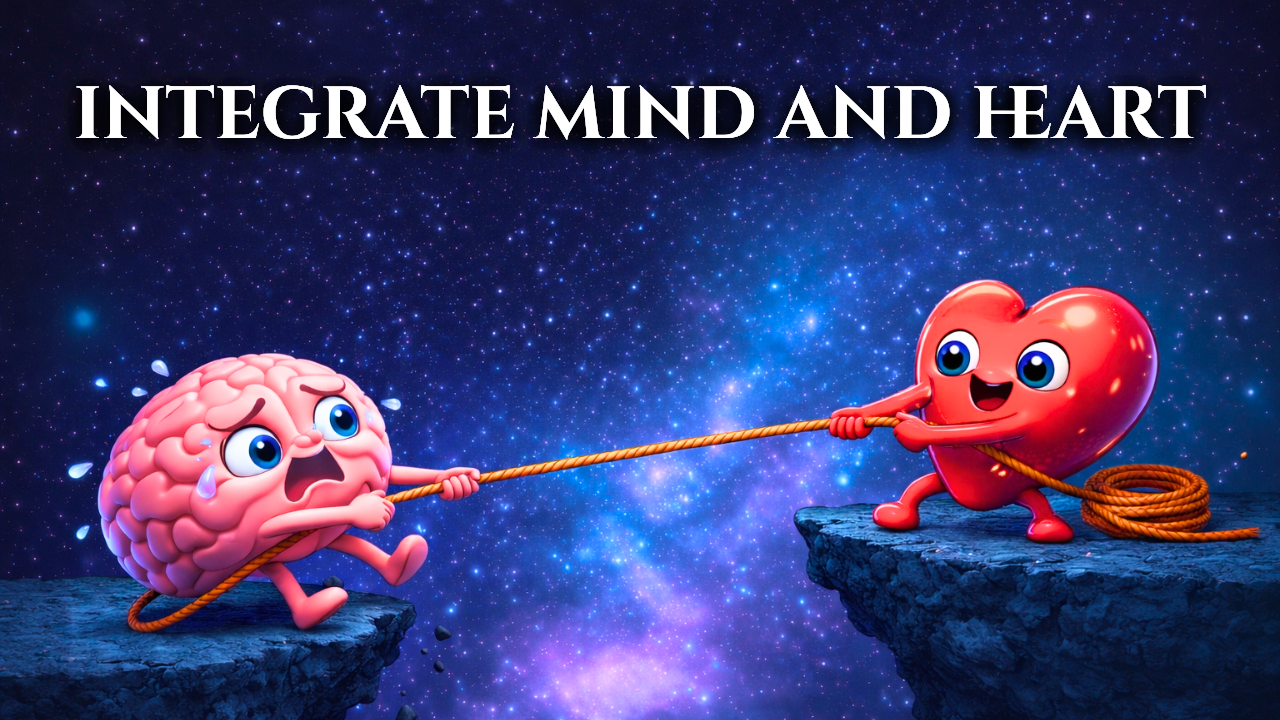
Clearly, the art of emotional intelligence is not in hiding from our emotions or listening to deeply to them: It's in integrating mind and heart together. It’s in integrating our parts so they collaborate rather than conflict.
Now we can finally answer what emotional intelligence really is.
What Is Emotional Intelligence And How Do You Build It?
Emotional intelligence is the integration of mind and heart, of all our parts, in navigating our false self, so we can pursue our True Self.
Our True Self is our deepest nature, where we attain true success, happiness, and love in college. The True Self does not reject the false self, it lovingly integrates it, and then transcends it. Rooted in our True Self, we feel calm, creative, compassionate, and courageous and yet the journey there is full of hardship, challenges, and pain. Though we always are our True Selves, we only awaken to it when we integrate and transcend our finite self to reunite with our fundamental Oneness with reality, with Spirit.
This is the insight all Spiritual traditions have been trying to bring us toward for millennia.
They’ve been trying to teach us how to reach for our True Selves through navigating our false ones. And a huge part of that is in building emotional intelligence.
With an understanding of what emotional intelligence is we can move to the most practical part of this post: How do you build emotional intelligence?
How To Build Your Emotional Intelligence
Building emotional intelligence in yourself comes in two pathways: Emotional awareness and emotional navigation. Let's look at both.
Emotional Awareness
Emotional awareness is the foundation of emotional intelligence because it’s the moment you stop being inside your emotions and start standing with them.
Building emotional awareness begins by building the depth of your self-witnessing. Ground in the awareness behind all experience. When you do this, emotions stop feeling like commands and start feeling like information. Anxiety becomes something you’re experiencing, not something you are. Sadness becomes weather passing through consciousness, not the climate of your identity.
As you witness more and more, your emotional vocabulary naturally expands. Instead of collapsing everything into “good,” “bad,” “stressed,” or “fine,” you begin to differentiate. Is this restlessness or boredom? Fear or grief? Longing or loneliness? Subtle emotional precision matters because you can’t integrate what you can’t distinguish. Naming emotions isn’t labeling for control—it’s clarifying the signal so it can be understood.
Alongside self-witnessing, journaling is another super powerful awareness builder. At first, you journal about your day—what happened, what you did, what was said. This is useful, but limited. Growth accelerates when journaling turns reflective: How did this experience affect me, what did I feel, and what part of me was trying to survive through that reaction? Over time, patterns emerge—not just in behavior, but in identity.
Through consistent emotional awareness, you begin to see your false self operating with compassion instead of judgment. You notice how emotions are trying to help you, even when they hurt. And from that understanding, you can move toward emotional navigation.
Emotional Navigation
Self-awareness lets you see emotions. Emotional navigation is what you do next.
The key move is the pause. When an emotion arises—anxiety before class, irritation with a friend, restlessness at night—you slow down just enough to create a choice point. From that pause, emotions can be navigated internally or externally.
Some emotions are best navigated internally through two methods: Re-soiling or re-seeding.
Re-soiling is the art of letting an emotion metabolize into something else. Anxiety becomes curiosity. Anger becomes clarity. Sadness becomes tenderness. This doesn’t happen by force. It happens by staying present with an emotion, loving it, and asking if it's okay with changing. If it is, which it might not be, you can ask with curiosity what it might turn into. For example, a student panicking before an exam might discover, beneath the fear, a genuine care for learning—or a longing to feel capable.
Re-seeding involves changing your self-concept so the emotion no longer has the same grip. If your false self is “I am a high achiever,” then a B feels like a threat. If your identity shifts to “I am someone who learns deeply over time,” the same grade carries far less emotional weight. Re-seeding doesn’t erase emotions; it changes the soil they grow in. The emotion still arises, but it no longer dominates consciousness.
Some emotions, however, are asking for movement in the world—action, not contemplation. Re-locating is external navigation—changing something tangible to support your inner life. Leaving the library when restlessness peaks. Saying no to another club when exhaustion sets in. Eating with friends instead of alone when isolation creeps up. This is external change rooted in internal awareness.
Internal Family Systems work ties all of this together. Different parts of you will advocate for different strategies—one part wants to push harder, another wants to rest, another wants to escape entirely. Emotional intelligence isn’t letting one part win. It’s listening to all of them from a centered place, then choosing the response that serves your growth rather than just your survival.
When emotions are navigated this way, they stop running your life from behind the scenes. They become collaborators—sometimes loud, sometimes inconvenient, but ultimately oriented toward helping you become whole.
The Conscious College Emotional Journey (Conclusion)
At the heart of our time together is a quiet but radical realization: We are never as rational as we think we are. In college especially, emotions are shaping our decisions, relationships, beliefs, and identities long before our reasoning steps in to explain them. Ignoring emotions doesn’t make us free—it just makes us blind to the forces already steering our lives.
Emotions aren’t mistakes or flaws to be eliminated. They are biases in how we relate to consciousness, each carrying information about how our false self is trying to survive. Anxiety, shame, excitement, restlessness, joy—none of these are random. They arise from interpretations rooted in identity, attachment, and self-survival. Events don’t cause emotions; our meaning-making does.
Because we are made of many parts, conflicting emotions are not a personal failure but a structural feature of being human. Different parts of us—career-oriented, relational, playful, protective—use emotions to advocate for their version of survival. Emotional intelligence begins when we stop letting one part dominate and instead learn to listen from a deeper center.
Building emotional intelligence isn’t about suppressing emotions or obeying them blindly. It’s about integrating mind and heart, our different parts, through self-awareness and emotional navigation—learning when to sit with emotions, when to reframe identity, and when to change something concrete in the world. This integration loosens the grip of the false self and creates space for something deeper to emerge.
And that deeper movement never truly ends.
Coming to your emotions with love, kindness, and compassion is not a one-time breakthrough—it’s a lifelong spiral. Again and again, you meet anxiety without judgment. Again and again, you soften toward shame. Again and again, you realize the parts that hurt are trying, imperfectly, to help you find safety, meaning, and belonging.
Each return deepens the path. Each act of compassion unfolds another layer of the false self. And slowly—quietly—you find yourself living less from fear and more from Truth. Not because the journey is finished, but because you’ve learned how to walk it.
That is the never-ending story: meeting your emotions with love, so you can keep awakening to who you already are, your True Self.

If you found this post interesting you would love my free College Freshman Cosmic Journaling Kit (CJK). ✨📚
It's a gamified journaling system that helps you grow your emotional intelligence, self-understanding, and purpose with over 1,000+ journaling questions and 5+ templates in just 15 minutes a day.