
😧The Stress Regulation Skill College Freshmen Are Missing
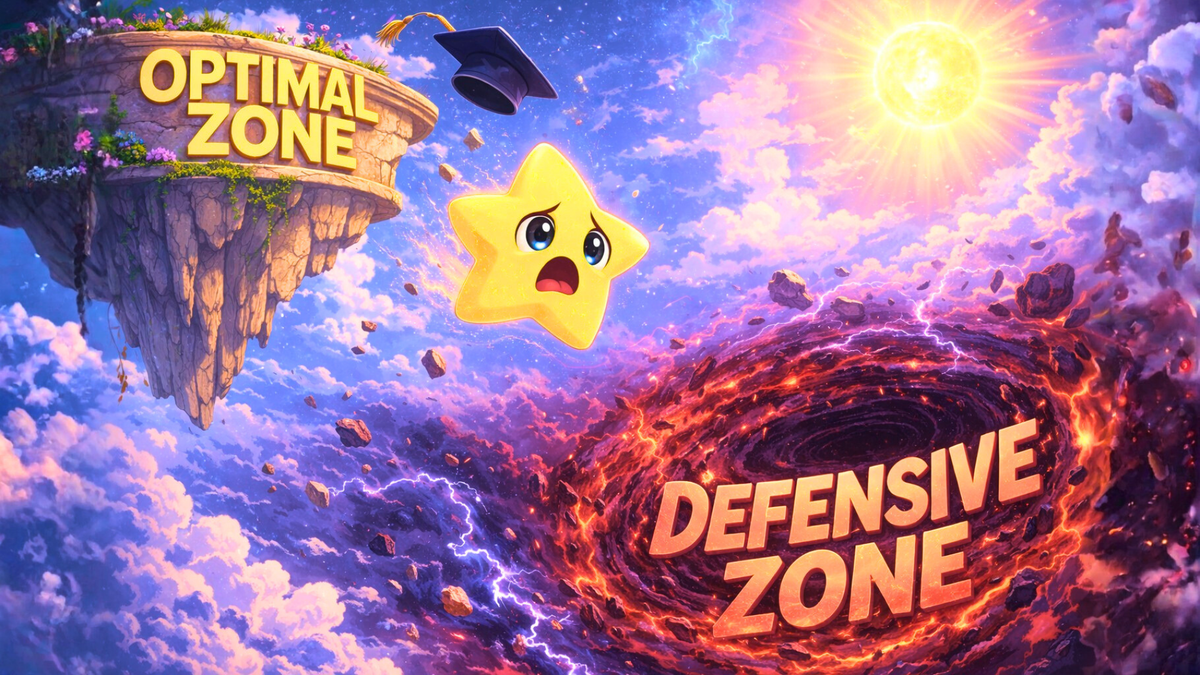
There's a skill most college freshmen lack, and it's the reason so many of us walk around campus depressed, restless, and stressed without understanding why.
The skill is called optimal zone resilience (OZR). It's the art of partnering with your autonomic nervous system (ANS) toward states of calm, connection, and energy, what researchers creatively call the optimal zone.
The problem? Without practice, the autonomic nervous system is exactly that. Autonomic. And lacking awareness, we get triggered constantly throughout the day, shoved into the defensive zone like a paper syllabus after the first day of classes. In the defensive zone, we can feel depressed, restless, and anxious.
I learned this the hard way.
During my sophomore semester at Cornell, I was building Obsidian University with my business partner John Mavrick. On the outside, everything looked great. I was maintaining a full course load, girlfriend, four clubs, content creation schedule, and six pack abs.
In actuality, I was falling apart like a badly made gingerbread house. My schedule was the icing holding the walls together, and every uncontrolled moment was a toddler poking their finger through. A friend spontaneously texting for lunch. A class discussion getting moved. A surprise Canvas assignment. Poke. Poke. Collapse. My gingerbread therapist was a large black coffee from 7-Eleven.
I was deep in the sympathetic dominant defensive zone.
The experience was so negative it launched the journey I've been on ever since. I huge part of my mission in helping college students is building optimal zone resilience (OZR) so they can navigate what I went through with half the suffering. To do this, over the last six years I've:
- Created 700+ YouTube videos, articles, and podcasts
- Taught hundreds of college students through Cornell Outdoor Education, workshops, and six self-made courses
- Worked with the world's #1 Gamification Consultancy, The Octalysis Group, where I learned to understand motivation and some of its roots in dysregulation
- Read 500+ books including The Body Keeps The Score, Thinking Fast And Slow, and Emotional Intelligence 2.0
All of which is to say: I've spent an unreasonable amount of time thinking about why college students feel terrible. My parents are thrilled.
In the last few months in particular, I've been a part of Dr. Robert Gilman's community Bright Future Now, where a major part of the curriculum has been learning about developing OZR. All of that has led to a map I want to share with you. We're going to explore why so many students are chronically in the defensive zone, where those triggers actually come from, how to uncover your personal ANS map, and how to build the missing skill of OZR.
By the end, you won't just understand your stress differently. You'll have a practice for navigating it.
Why Are So Many Students Chronically In The Defensive Zone?
To understand why you keep ending up depressed, restless, or stressed, you need to understand what the autonomic nervous system actually does.
The ANS is the part of your nervous system that regulates breathing, heart rate, and digestion without needing your conscious input. It's ancient, with origins going back over 500 million years. Beyond regulation, its other major role is threat detection. Through a process called neuroception, the ANS constantly scans your environment to determine whether your situation is safe or threatening.
If it's safe, you can be in your optimal zone, yay! But if it's not, it's the ANS's job to put you into the defensive zone. This is great. You want a functional ANS because otherwise, well, you likely wouldn't be reading this and reveling in my incredible prose writing abilities. And I need you alive because my YouTube analytics are already dire enough.
Here's the catch: The ANS can't tell the difference between a bear and a bad grade.
This threat detection system evolved on the savannah. It was designed for lions, rival tribes, and poisonous berries. Now it's operating in an environment of Canvas notifications, social comparison, and dining hall small talk. And it's still detecting threat triggers everywhere.
As a result, though most students are perfectly physically safe, psychologically we're walking defensive zone vortexes.
Where Do These Triggers Come From?
If you zoom out, triggers come from four interconnected spaces. I think about them through the lens of Ken Wilber's Integral Theory's quadrants, but you don't need the theory to get the point.
The first is the I space: your inner world. Triggers come here because most students aren't building OZR personally or in classes. No meditation habit. No reflection practice. No conscious relaxation ritual that isn't Netflix and a pint of ice cream (which, to be fair, has its merits). We take classes on organic chemistry and medieval literature, but nobody sits us down and says: "Here's how to notice when your mind is screaming at you, and what to do about it."
The second is the We space: your culture and relationships. Our social norms don't promote emotional awareness, especially for guys. Deep emotional conversations are rare in most friend groups. And sometimes, the relationships themselves are the trigger. The friend who only reaches out when they need something. The group chat that runs on sarcasm and subtle competition. The roommate whose lifestyle choices keep your nervous system on high alert at 2 a.m.
The third is the It space: your body and immediate environment. Unfortunately, most students exercise is the walk to and from classes. And hell doesn't exist out there, it exists in college men's dorm rooms. Chronic nutrition, sleep, and exercise difficulties alongside an immediate environment not made to calm or inspire us are another contributor to the defensive zone.
The fourth is the Its space: systems and structures around you. Dorms with no quiet spaces. Social media architectures designed for comparison. Grade curves that pit students against each other.
Here's where it gets tricky. Students mistake these triggers as purely external realities, things happening to them that they can't control. But every external challenge is rooted in an internal one. The student who blames the professor for exam stress might actually be avoiding their own time management shadow. The student frustrated by a friend who "caused" a conflict might be avoiding their own responsibility in the dynamic. The student who hates their body because they're in a society that values physical attraction too highly.
This doesn't mean external factors don't matter.
They absolutely do. But the journey to rooting in the optimal zone starts with learning to navigate your internal world. How do you do that? The first step is learning the two paths to the defensive zone. Most students only know one.
The first path is the acute trigger. An exam date announced two days early. A friend saying something that cuts deeper than they intended. A grade that shatters the narrative you've been telling yourself about your competence. These triggers hit like a wave, and you know you've been knocked off balance.
The second path is chronic triggering. Perpetual busyness without rest. A nagging lack of purpose humming underneath everything. No conscious relaxation habits. This kind of triggering is gradual like the water level rising so slowly around you that by the time you realize, you've already been drowning for weeks. You're the frog in the boiling pot, except the pot is your Google Calendar and the heat is set to "pre-med."
Two distinct pathways in, and they compound each other. Chronic depletion makes your system vulnerable to disproportionate collapse from relatively minor triggers. Most students only notice the wave. They miss the water level entirely.
As we begin to understand the ANS, and why we are triggered into the defensive zone, we can move into the six different ANS states, both optimal and defensive. Because with awareness comes the power to change.
Uncovering Your ANS Map
The ANS isn't a switch between "fine" and "not fine." It's a continuous landscape with six distinct regions, three in the optimal zone and three in the defensive zone.
What determines whether you're in the optimal zone or the defensive zone is one thing: whether your ventral vagal system is online.

The ventral vagus branch is one half of your parasympathetic nervous system, the system that controls regulation when you're safe. When offline, the other branches — dorsal vagus and sympathetic — operate under threat without that anchor. Same activation, completely different experience.
The dorsal vagus, the other part of the parasympathetic system, is responsible for regulation of the lower body regions, inner functions. The sympathetic system is the part of our ANS designed for fight and flight, outer functions. Each of these three parts of our ANS can create six different combinations with feelings mapped to each. I'm borrowing an image by Robert Gilman's Bright Future Now to show just how.

And you can map where you are at any given time by identifying the feelings you're having with their place on the map.

Let's get more clarity on each part of the map so you can become a master mapper.
The Defensive Zone has three regions.
Dorsal vagal dominance is the lower left. This is withdrawal, shutdown, depression with an inner focus. Your heart rate drops, thinking slows, memory gets impaired, and taking action feels like pushing through wet cement. At the mild end, there's a subtle fog, a flatness. Things that would normally interest you don't land. You cancel plans, scroll instead of engaging. At the moderate end, hopelessness shows up and self-care deteriorates. At the extreme end, this is full shutdown, and professional support is needed.
Sympathetic dominance is the bottom right. Fight-or-flight territory with an outer focus. Heart rate spikes, attention narrows, thinking becomes rigid and categorical. At the mild end, you're just irritable. Shortened fuse. Mentally rehearsing arguments nobody asked for. At the moderate end, you're in full reactive mode: trigger, react, blame, repeat. At the extreme, it's pounding heart, tunnel vision, rage or terror.
Dorsal-sympathetic blend is the bottom center. This is the least recognized region and the most confusing since its both inner and outer oriented. You care enough to be distressed about not doing the work but can't marshal the resources to do it. This is the state where you draft an email to your professor explaining you need an extension, rewrite it four times, and then close your laptop without sending it. Productivity. At the mild end this can create a subtle wired tiredness. In moderate states, this can feel like you want to crawl out of your skin. And at the extreme end, it can be an unbearable tension crawling under your skin like a parasitic worm.
The Optimal Zone also has three regions.
Ventral-dorsal blend is the upper left. Here, the body is oriented towards restorative inner functions often through meditation, mindfulness, or journaling. At the emerging level, rest is fragile and residual tension persists. At the attuned level, tranquility becomes reliable and contemplative depth opens up. At the embodied level, the body becomes a field of living awareness.
Ventral vagal dominance is the relational core, center of the optimal zone. It's neither internally oriented or externally but a balance of both. This is where you're most capable of compassion, deep listening, and genuine connection. At the emerging level, safety is new and you're still self-monitoring. At the attuned level, you can sit with discomfort in yourself and others without being destabilized. At the embodied level, presence feels less like a condition you maintain and more like your nature.
Ventral-sympathetic blend is the creative wing optimal zone focused externally. Sympathetic energy held in safety. Creative drive, vigorous play, exploration, flow. At the emerging level, the energy is real but edgy. At the attuned level, you can think fast and think wide at the same time. Flow states open up. At the embodied level, action becomes almost transparent to intention.
I encourage you to map where you are on the ANS throughout your day. Just notice. It's invaluable. When I first started, I discovered I tend to live on the right side of the map: too much sympathetic energy, restlessness masquerading as productivity. That awareness alone changed everything. Because once you know where you are, you can start building the skill of getting back.
Developing The Missing Stress Regulation Skill: Optimal Zone Resilience
Optimal Zone Resilience isn't about never getting triggered. You will get triggered. Constantly. The skill is in how you come back through three steps.
Step 1: Witness and Embrace
There's a part of you that can watch the trigger without being the trigger.
I call this Self-Witnessing: grounding in the awareness behind all consciousness with non-judgment, non-clinging, and love. You don't need to be a meditator to start. You just need to notice there's a gap between the storm inside you and the awareness noticing the storm.
It helps to partner with your body. A few slow nasal breaths. Release the jaw. Drop the shoulders away from your ears.
As you feel the defensive zone pulling you under, name what's happening. "I'm triggered. My chest is tight. My thoughts are racing." Don't argue with it. That's just another form of the defensive zone wearing a self-improvement costume. Embrace the feeling.
If you feel resistance to embracing, that resistance is itself something to witness. (I know. It's turtles all the way down.)
Step 2: Reflect
Once you've created space, get curious. What triggered you? How is it affecting you right now, in your body, your emotions, your thinking? And the deeper question: why is it affecting you this way?
This connects directly to journaling. Level 1 journaling is writing about what happened. Level 2 is writing about how it affected you and why. Level 3 is making decisions rooted in the self-understanding you've uncovered. Most students never get past Level 1. They describe the event and stop. The magic lives in Level 2 and 3.
Step 3: Re-soil, Re-seed, or Re-locate
Imagine your inner world as a garden. Your emotional state is the soil. Your self-concept is the seed. Your external environment/behavior is the location. When something goes wrong in a garden, you have three options.
Re-soiling means changing the emotional texture directly. You're angry, and you consciously shift the emotion into something more workable. It could be anxiety into excitement. Shame into love. Or anger into anticipation for exercise. You're changing the soil so something different can grow.
Re-seeding means changing your self-concept to shift your relationship to the challenge. The exam didn't go well, and instead of spiraling into "I'm not smart enough," you plant a different seed: "This is data about my study method, not my identity." You're rooting learning from failure deep into your identity. You're not changing what happened. You're changing who you are in relation to what happened.
Re-locating means making an external change to navigate the internal challenge. Leaving the room. Going for a walk. Changing your study spot. Sometimes the nervous system needs a literal change of scenery or behavior to remember that safety exists.
The beauty of these three moves is that they work together. You might re-locate to a quiet spot on campus, do some diaphragmatic breathing to re-soil, and then journal through a re-seeding of the belief that was holding you hostage. One practice, three layers.
And this builds cumulatively. Each cycle through the process reduces the charge around whatever defense was triggered. It gives your brain fresher memories of how you can respond, slowly replacing the old groove with a new one. Start with mild triggerings as practice ground rather than waiting for the dramatic ones. With repetition, witnessing, reflecting, and responding can happen in quick succession. The goal, again, isn't to never be triggered. It's to move back toward the optimal zone in a skillful way whenever you are.
So, now, we've talked about what the defensive zone is, where our triggers come from, and how to build optimal zone resilience. But there's a deeper question underneath all of it.
Why Do We Get Triggered In The First Place?
It's really profound.
The answer lives in what I call self-survival: the process through which your false self continually re-creates itself through attachment. Your triggers aren't random. They're the mechanism through which the version of yourself you've constructed maintains its existence. The student who gets triggered by a bad grade isn't just disappointed. Something deeper is threatened: an identity, a story, a sense of worthiness that was built on academic performance. The trigger is the false self trying to survive.
This goes far beyond stress regulation. It touches the very foundations of who you think you are in college. But that's a longer journey.
For now, sit with this question: What if the thing keeping you in the defensive zone isn't the trigger, but the self that needs the trigger to keep surviving?
You don't need to answer it today. Just let it breathe. Let it plant itself somewhere in the back of your mind. It will always be there.
Because the optimal zone isn't a place you arrive at and never leave. It's a place you learn to return to, again and again, with a little more grace each time. One day you'll be almost entirely in the defensive zone, wondering why in goodness gracious you choose to continue living each day. Another, you'll spend so much time in the optimal zone it feels like cheating.
And maybe that's the whole point. Not to build a life where nothing triggers you. But to build a relationship with yourself honest enough, patient enough, and loving enough to come back home when it does.

If you found this post interesting you would love my free College Freshman Cosmic Journaling Kit (CJK). ✨📚
It's a gamified journaling system that helps you grow your emotional intelligence, self-understanding, and purpose with over 1,000+ journaling questions in just 15 minutes a day.