🌱The Root Of ALL Your College Freshman Challenges
Over the last six years, I've written over 400 articles on this blog, but I really only needed to write this one.
If you only read one thing out of everything I've published, THIS is it. Why? Because the insight I talk about here is the root of every challenge we go through in college. Every. Single. One.
I know that sounds dramatic, but I truly believe it. I wish this was an intro class required in middle school. But until the world is more developed, we'll have to learn it through an article written by a 5'10 Dutch Cornell University grad.
The insight is simple. That's what makes it so deceptive.
The root of ALL our college freshman challenges is the false self.
What Is The False Self?
Seven months ago, the person I thought was the love of my life broke up with me. I'd given her everything I had. Poems, songs, Texas tickets, late nights coaching each other through our deepest wounds. I rearranged my entire post-graduation life to stay in Ithaca with her. I got a remote job so I could be close. I poured so much of myself into that relationship that by the end, I couldn't tell where I stopped and it began.
When it fell apart, I didn't just lose a partner. I lost the version of reality I'd been living in.
Because here's what I saw in the wreckage: my perception of her, of the relationship, of my own happiness, had been warped for months. I'd been so fused with the identity of "person who loves deeply and makes it work" that I couldn't see what was actually happening. I ignored patterns that twelve different people in my life could see clearly. I reinterpreted lies as misunderstandings. I mistook exhaustion for devotion. I watched myself spiral into sleepless weeks, barely functional at my job, crying on walks around Beebe Lake for the 962nd time, and still believed the story my self was telling me: that if I just tried harder it would all come together.
It didn't. We broke up at the beginning of her Senior year, leaving me with a year long lease in a city I no longer wanted to be in.
I'll forever be grateful because the collapse cracked something open.
For the first time, I saw my false self not as a concept I'd read about in Ken Wilber books, but as the living thing that had constructed my entire experience of that relationship. The neediness, the lack of control, the inability to walk away: those were a form of love, but not the real thing. They were survival strategies dressed in love's clothing. Seeing myself at my worst gave me something I couldn't have gotten any other way: I finally understood, in my bones and not just my brain, what the false self, and ultimately the thing which roots all challenges really is.
The false self is the finite character we build and attach to throughout life to help us survive, physically and psychologically. It's made of our achievements, our friend groups, our major, our aesthetic, our opinions about oat milk. Over time we mistake this character for who we actually are. And because the character is often under threat (a bad grade, a rejection, a friend who stops texting back), we spend enormous energy keeping it alive.
The false self isn't one monolithic villain. It's more like a committee. Richard Schwartz's Internal Family Systems work (which he explores in No Bad Parts) shows that we're made of many parts, each trying to help us function and belong in their own adapted way. Some parts are protectors. Some are exiles, wounded from experiences we never fully processed. All of them are doing their best with what they've got (check out my article on IFS therapy to learn more about this).
Self-compassion matters here. The false self is trying to help. It's protecting us in the way it's learned based on the environment it formed in. It's simply not equipped to make us Absolutely successful, happy, or loved.
This is where it gets even more profound: The false self survives.
Self-survival is the process through which our identity continually re-creates itself through attachment: clinging to things being one way and suffering when they aren't. We do it individually. We do it collectively, through friend groups, institutions, and entire cultures that reinforce certain identities and reject others.
And here's the part that sounds strange until it clicks: survival isn't just a physical thing. Most of us can understand survival in a Darwinian sense, animals eating each other on the savanna, the circle of life, Simba being held up over a cliff. But survival is a law that runs deeper than the physical. Psychologically, it's what keeps our identity going. The part of us that flinches when someone questions our major and the tightness in our chest when a friend group shifts without us. All survival.
The false self isn't just negatively valanced. It includes all the positive aspects of us as well. The work ethic, kindness toward strangers, love for our friends. Simply put, it's the character we attach to, negative and positive included.
All self or collective survival is an act of love. The difference is in the degree of selfishness. A criminal robbing a bank is a very low degree of love. But it's still love. They're robbing out of love for money, or their desperate family, or for the criminal identity. Then, you have higher forms of love in survival. Your parents paying for you to go to college. Donating to charity.
And it doesn't just live inside us. Books like Annie Murphy Paul's The Extended Mind show that our cognition extends into our relationships, technologies, and environments. It reaches into the group chat, the Instagram feed, the layout of our dorm room, the Spotify playlist we put on when we need to feel like a certain kind of person.
When my mother went to college, she still needed to write letters to talk with her parents. Now, I can WhatsApp her from across the globe. My perception of space, of time, of relationships has fundamentally shifted alongside the technology. Our self is distributed. Which means our survival is too.
The question is, what is the false self keeping us from?
The True Self is our deepest nature, where we find success, happiness, and love that don't collapse every time our circumstances change. The True Self doesn't reject the false self. It lovingly integrates it, then transcends it. Rooted in the True Self, we feel calm, creative, compassionate, and courageous. The journey there is full of hardship and pain. We always are our True Selves; we just don't know it yet. We only wake up when we integrate and transcend the finite character we've been clinging to and reunite with something much larger.
I call this the Conscious College Journey: the hero's journey of moving from the false self to awakening to the True Self.
It's what all of my content is pointing towards in one way or another, whether it be through discussing AI, meta-learning, or journaling. It's what I began truly pursuing after my break up. In order for you to begin the journey, we must understand why the false self exists.
Why Does The False Self Exist?
The false self didn't show up randomly. It formed as a survival strategy in response to our environment. Just as organisms adapt to physical environments, we adapt to psychological ones. A teenager who gets praised for grades becomes a sophomore who checks Canvas at 3 AM, religiously uses AI, and finds conscious relaxation absolutely impossible. A twenty-two year old who builds his identity around loving deeply becomes someone who can’t walk away from a relationship even when twelve people in his life are begging him to.
These survival strategies aren't good or bad. They just are. Some are negatively coded: avoiding intimacy because vulnerability once meant getting hurt. Some are positively coded: being generous because kindness was reciprocated early on. The problem comes when a strategy that helped us at fourteen is still running the show at nineteen.
When our growth involves skipping over the hard parts, those unprocessed experiences become shadows. A shadow is a part of the false self we've attached to through addiction (so close to it we can't see it) or allergy (so avoidant of it we pretend it doesn't exist). The student who can't stop overworking and the student who can't start working are often running from the same wound (check out my article on shadow journaling to explore your own).
While there are countless environments we adapt to, a few are universal for college students.
Childhood development is the big one. We all start without a sense of self, merged with our primary caregiver. Then we develop a first-person perspective, wildly egoic, the world revolving around us like we're a tiny narcissistic sun. Then second person: we can stand in someone else's shoes. Then third person: we can think about two people interacting from outside the interaction. If you're blessed with an incredible childhood, you might develop a fourth person perspective, in which you can stand outside multiple third person perspectives and compare them to each other. Each development transcends and integrates the previous one. But if something goes wrong at any stage, if the environment is neglectful or chaotic or just confusing enough, we develop survival strategies that calcify into the false self we carry into our first college dorm room.
Relationships shape the false self in ways most of us don't notice until we're deep into them. Attachment theory research shows that the bonds we build with primary caregivers in infancy ripple forward. Maybe we feel secure enough to be intimate with others. Maybe closeness feels threatening because of a terrible breakup, so we keep people at arm's length. Maybe we need constant reassurance because connection once felt unreliable.
Career and finances add their own layers. Some of us arrive at college convinced that career success is the only thing standing between us and worthiness. We grind through internship applications like we're stacking sandbags against a flood of inadequacy. Others swing the opposite direction, performing casualness about money while quietly panicking.
Culture is the quietest sculptor. Most of our parents are Boomers or Gen X, meaning they grew up in a world so different from ours it might as well be a separate planet. Gen Z tends to be more purpose-oriented, lonelier, and more anxious. Some of that is a historical trend toward more liberal culture. A lot of it is technological. Social media gave us a thousand mirrors to check our false self against every hour. The internet collapsed the distance between us and everyone else's highlight reel. We are simultaneously the most connected and least close generation in human history.
And we don't just have one false self. It shifts, it ebbs, it changes. The self you are now is likely very very different from the one you had at 10 years old. In fact, the self you were five seconds ago is different from the one now, although not by very much.
As we transition through the chapters and seasons of life, our false self changes with us. Most of us have already experienced 3-4 monumental transitions by the time we get to college. My article on College Freshmen ego development tracks the patterns in this development.
One thing remains true among all the change: the false self always creates challenges. This is what allows us to finally answer the question.
How Does The False Self Root Our College Freshman Challenges?
Here's where the simplicity of this insight becomes almost uncomfortable.
The ONLY reason something registers as a challenge is because our false self defines it as one.
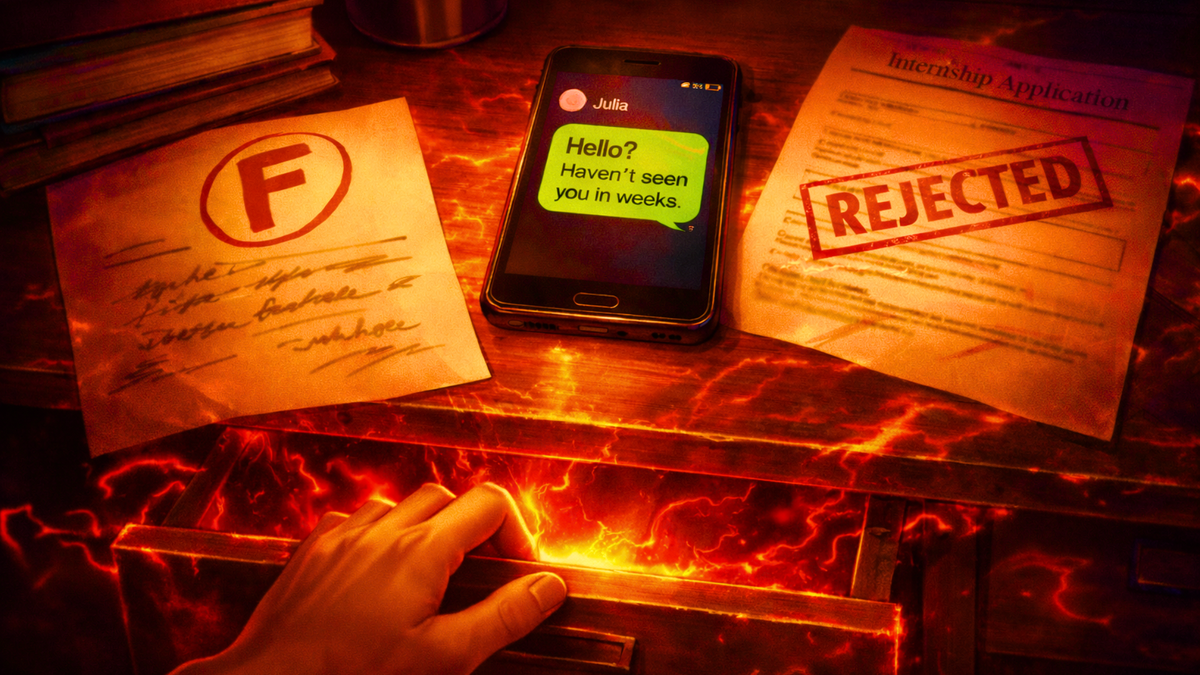
We don't judge reality. We judge our false selves. A C+ on an exam isn't painful because of the letter. It's painful because of what our false self makes that letter mean: I'm not smart enough, I'm falling behind, my parents will be disappointed, I picked the wrong major, I'm going to end up living in a van (and not the Scooby Doo variety).
The external world doesn't affect us directly. Our relationship, our judgements, about it does. A rejection from a club means nothing to someone who never wanted in. It shatters the person whose self-worth was quietly pinned to getting accepted.
I want to be careful here because this can sound like toxic positivity if I'm not. The point isn't that the external world doesn't matter. Most of us aren't awake enough to snap our fingers and stop being affected by a breakup or a failed exam. We're responsible for how we perceive things, but we're not always at fault for the incoming material.
A student dealing with financial stress or family crisis isn't suffering because they have the wrong mindset. They're suffering because real things are hard, and the false self makes them harder by adding layers of story, identity, and fear on top of what's already painful.
I call this added layer self-smog: perception of reality clouded by self.
The needier the self, the thicker the smog. Self-smog doesn't just distort how we feel about things. It shapes what we notice in the first place. During those last months of my relationship, the smog was so thick I couldn’t see three feet in front of me. I reinterpreted lies as misunderstandings. I mistook her exhaustion for devotion. I watched the pattern repeat and repeated my own story louder to drown it out. That’s what self-smog does: it doesn’t just blur reality, it replaces it with a version that keeps the false self alive.
The false self creates challenges from every dimension of college life. Internally, it shapes our thoughts, emotions, and the stories we tell ourselves at 1 AM. Physically, it lives in the body: the tight shoulders, the shallow breathing, the way our nervous system fires when we see an ex at the dining hall. Bessel van der Kolk's The Body Keeps the Score documents how unprocessed psychological experience stores itself somatically; our false self doesn't just think its way through college, it clenches its way through (check out my article on Optimal Zone Resilience to understand how this plays out in your nervous system day to day).
It's way deeper than we might think. It doesn't just shape our challenges. It shapes what we find true or not. Most people's definitions of truth have nothing to do with Absolute Truth; it's a relative truth so thoroughly ingrained in the survival strategies of their false self that they must believe it. In fact, I'd go as far as to say most of the worlds problems come from false selves fighting false selves. Check out my article on what elite college freshman get wrong about truth to learn more.
Whew. You doing okay there? It's quite some insights, I know. Take a breather if you need. When you're ready, let's head to something more light and hopeful.
How To Befriend The False Self To Navigate Challenges
Here's the trap most of us fall into the moment we learn about the false self: we try to destroy it, go Super Saiyan on it if you will. We read an article like this one, feel a burst of insight, and then add "transcend ego" to our self-improvement to-do list right between "drink more water" and "finally learn to cook something that isn't pasta." The false self loves this move. It just absorbed the insight and made it another survival project.
Befriending the false self is different from fixing it.
The false self is not a villain. It's trying to help you, to protect you, in the ways it learned to. The art is not in attacking it, but dancing through life alongside it.
Befriending the false self begins with self-witnessing: the practice of grounding in the awareness behind all our thoughts and feelings, and watching what arises without judgment or clinging. Not analyzing. Not solving. Just noticing. Meditation works for this, but so does a walk across campus where we pay attention to the sensations in our body.
The body is the entry point most of us skip. The false self lives in the way our jaw tightens before a difficult conversation, the shallow breathing we don't notice during an exam, the heaviness in our chest on a Sunday evening that we can't quite name. Van der Kolk's work shows that psychology and physiology are not separate systems; they're one system wearing two hats. When we build somatic awareness, we start to catch the false self as it activates.
Once we've built some awareness, journaling becomes the conversation we have with ourselves about what we noticed. Three questions to sit with:
- How am I still surviving the identities I developed when I was younger?
- What survival strategies are no longer serving me?
- How are the people around me acting out their own survival strategies?
Self-witnessing and journaling are what helped me navigate the hardest period of my life. It was seven months ago, on a walk around that same lake I’d circled hundreds of times, I finally caught my false self mid-act.
Not in a book. Not in a meditation. In the wreckage of the most important relationship of my life. For the first significant time I chose to sit with it instead of feed it. The smog thinned. Just a little. Enough to see that the person walking around that lake was someone worth being kind to.
We don’t befriend the false self because it fixes everything. We befriend it because it’s the only way to stop building towers out of need and start building them out of choice. None of this happens overnight. The false self took years to build. It won't be befriended in a weekend workshop or a single journaling session. But every time we catch it mid-act and choose curiosity instead of autopilot, something shifts. The smog thins. The relevant things change.
I see a world in which college doesn't just build students resumes and job prospects, it builds their knowledge, love, and consciousness. A world in which we learn to befriend our false selves as much as we learn linear regression and academic writing. A world in which people lead with their True Selves in every interaction.
It starts with you.
Every moment, every interaction, that you root deeper in your True Self is an opportunity to ripple out the growth in others. Until one day we can all look back and see how far we've spiraled toward the stars.

If you found this post interesting you would love my free College Freshman Cosmic Journaling Kit (CJK). ✨📚
It's a gamified journaling system that helps you grow your emotional intelligence, self-understanding, and purpose with over 1,000+ journaling questions in just 15 minutes a day.